 RaiseUp
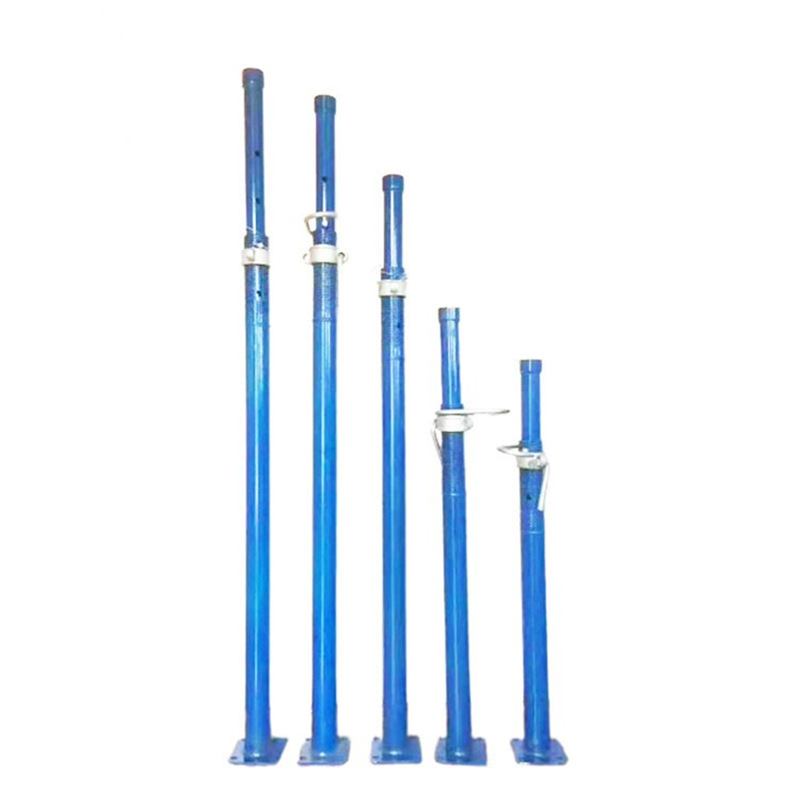
Props fail in a small number of predictable ways, and almost all of them are visible before the pour. A ten-minute inspection per floor is cheaper than any repair order, so this checklist is written to be used, not filed.
1. Thread and nut condition
The adjusting nut carries the entire load on an adjustable prop. Check for:
- Flattened or sharp-edged thread crests — a sign the nut has been run under load
- Thread engagement of at least 100 mm and no more than two-thirds of the thread length
- Nut spinning freely by hand when unloaded; a nut that needs a wrench to move is already galling
2. Sleeve play
With the prop upright and unloaded, grab the inner tube and shake it. Visible rattle means the sleeve has worn oval. More than about 2 mm of lateral play at the top reduces the prop to an eccentrically loaded column, and the capacity drops accordingly.
3. Pin and locking device
Every telescopic prop has a pin or collar that must be fully through the tube. Check that the pin is present, straight, and retained by its chain or clip. Missing pins are the most common single defect in a mixed rental fleet.
4. Straightness
Roll the prop on a flat slab. A prop that wobbles has a bend, usually from being used as a lever. Any permanent bow over roughly 1:500 of its length means retire it — straightening a prop does not restore its capacity.
5. Base plate and U-head
- Base plate flat, not dished or bent at the corners
- U-head opening wide enough to capture the bearer, and not splayed
- Welds at plate and head continuous, with no undercut or visible crack
- No concrete or mortar built up in the U-head; it prevents the bearer seating
6. Weld inspection
Look at three places: base plate to tube, U-head to tube, and the collar or nut housing. A crack usually starts as a rust line at the weld toe. Any crack — however short — means the prop is out of service.
7. Extension and rating
Read the actual extended length, not the nominal one. Capacity falls quickly with height:
| Extended length | Typical allowable load (48 mm prop) |
|---|---|
| 1.8 – 2.2 m | 20 kN |
| 2.5 – 3.0 m | 15 – 18 kN |
| 3.2 – 3.6 m | 11 – 13 kN |
| 3.8 – 4.0 m | 8 – 10 kN |
If a bay needs a prop beyond about 3.6 m, use a shoring tower with ledgers rather than a taller single prop.
8. Sole plate and ground bearing
The prop is only as strong as what it stands on. Check that every prop has a sole plate, that the plate is in full contact, and that the ground is compacted. On suspended slabs, confirm back-propping below.
9. Plumb and alignment
Check plumb with a level on two faces. Tolerance is typically 1:200. A prop leaning 1:100 has already lost a third of its buckling resistance.
10. Documentation
For every pour you should be able to produce: the prop batch certificate, the load calculation for the grid, and a signed pre-pour inspection record. If a failure happens, this paperwork is the difference between an insurance claim and a liability finding.
Retire, do not repair
Props are cheap; the failure is not. Set a clear retirement rule and stick to it:
- Cracked weld anywhere → scrap
- Bend beyond 1:500 → scrap
- Thread worn more than 25% of crest height → scrap
- Sleeve play over 2 mm → scrap
- Galvanising gone and section loss visible → scrap
We supply telescopic steel props and adjustable steel props with per-batch load test certificates, and we can include a printed inspection card for each container so your site team has the checklist in hand. If you are replacing a mixed fleet, send us your current prop mix and heights and we will match it.