 RaiseUp
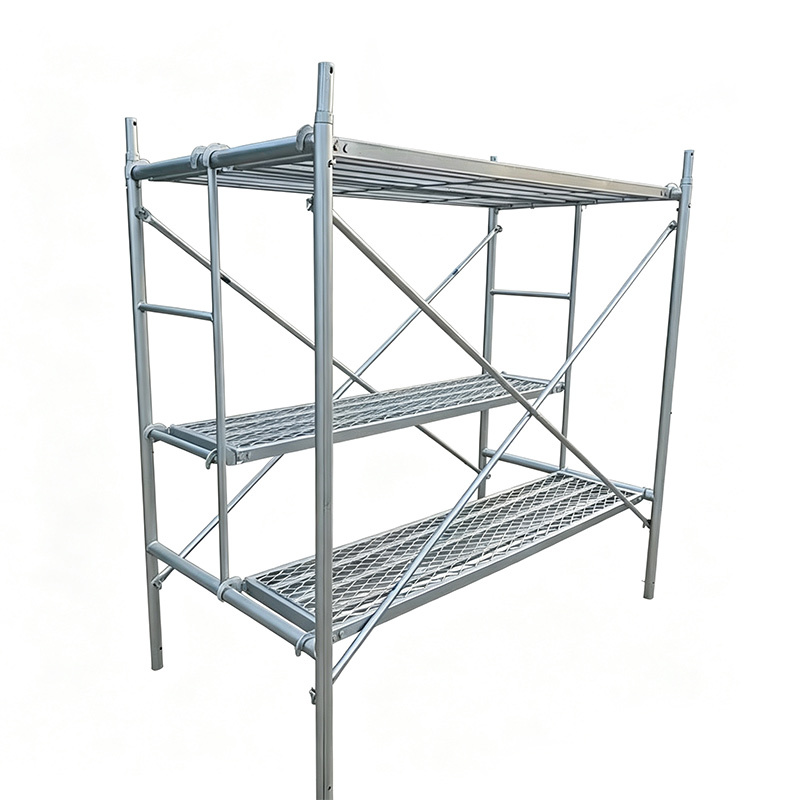
Ringlock and cuplock are the two modular systems that dominate scaffolding worldwide, and buyers routinely ask which one is “better”. There is no universal answer, but there is a clear answer for each project type once you look at the node, the assembly method and the labour rate you are paying.
The node is the whole difference
Cuplock uses a bottom cup welded to the standard and a top cup that slides down over the horizontal end blades. One hammer blow on the top cup locks up to four horizontals at once. It is forgiving: the joint tolerates dirt, slight misalignment and damaged blade ends.
Ringlock uses a rosette — a punched steel disc with eight holes — welded to the standard every 500 mm or 1,000 mm. Ledger and diagonal ends have a forged head that drops into a hole and is secured by a wedge. The joint is positive: the wedge either goes in or it does not, which makes inspection unambiguous.
That single design decision drives everything else.
| Cuplock | Ringlock | |
|---|---|---|
| Connection | Sliding cup + hammer | Rosette + wedge |
| Horizontals per node | Up to 4 | Up to 8 (any angle) |
| Diagonal attachment | Needs separate coupler in most systems | Direct into rosette |
| Assembly speed | Fast | Faster on complex geometry |
| Load per standard (typical) | 20–30 kN | 30–40 kN |
| Tolerance to site dirt | High | Medium |
| Repair cost per damaged node | Cup replacement | Rosette weld repair |
Assembly speed in real numbers
On a straight facade with only ledgers, cuplock and ringlock are close — both around 25–35 m² per man-day for a trained crew. The gap opens on geometry:
- Curved or angled layouts. Ringlock takes diagonals and ledgers at 45° increments without extra parts. Cuplock needs couplers, which means extra fittings and extra time.
- Loading towers and birdcages. Eight-way rosettes let you run horizontals in every direction at a single node. Cuplock tops out at four.
- Stair towers. Ringlock stair flights land on rosette nodes; cuplock usually needs a coupler adaptor.
If your work is repetitive straight-run access, the speed difference is small enough that price and availability should decide. If your work is industrial, curved, or heavy-load towers, ringlock wins on labour.
Load capacity and standards
Ringlock standards are commonly 3.2–4.0 mm wall with 30–40 kN permissible leg load; cuplock standards typically 3.2 mm with 20–30 kN. Both are certified to EN 12810/12811 in Europe and to local codes elsewhere. The capacity difference matters most for:
- Sheeted facades in high wind zones
- Loading bays and material platforms
- Shoring towers supporting heavy formwork
If you are close to the capacity limit on cuplock, you are usually better off changing system than adding standards.
Cost: purchase price is not the number
Compare total cost per square metre of erected scaffold:
- Material cost — ringlock is typically 10–20% more per tonne, because of the forged heads and rosette welding.
- Labour — the deciding factor in markets with high labour cost. A 15% speed gain on a 10,000 m² project pays for the price difference several times over.
- Loss and damage — cuplock cups are robust; ringlock wedges are small parts that disappear. Budget for replacement wedges at 2–4% per year.
- Mixed fleets — do not run both systems on the same site unless you have to. Conversion losses and confusion cost more than either system.
What we recommend
For export projects in the Middle East, Latin America and Africa where labour is available and budgets are tight, cuplock remains competitive for straight facade access. For industrial maintenance, curved structures, stair towers and anything with a heavy load case, specify ringlock.
We manufacture both, in 48.3 mm tube with hot-dip galvanising to 60–80 µm, and we will quote the system that fits your project rather than the one we have in stock. Start with the scaffolding system range or send a drawing for a layout and bill of quantities.