 RaiseUp
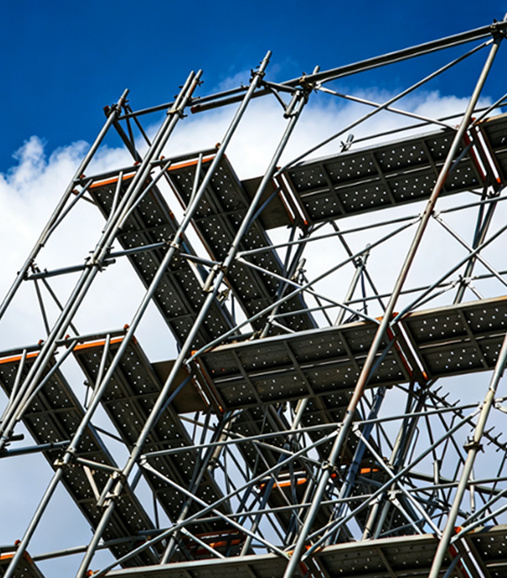
A frame with four columns and no bracing is a mechanism, not a structure. It stands still in a drawing and racks sideways the moment wind or an eccentric load arrives. Bracing is the cheapest part of the frame and the part most often value-engineered out — which is exactly why site failures cluster around it.
The four types you will meet
Cross bracing (X-brace). Two diagonals crossing in a bay. The stiffest option per bay and the default for scaffold facades and tower legs. Tension-only in theory, but both members should be capable of compression if the load reverses.
Single diagonal bracing. One diagonal per bay, alternating direction between bays. Cheaper, still effective, but leaves one direction of sway less restrained per bay — use it where the frame is braced in the other direction by a core or wall.
K-bracing. Diagonals meeting at mid-height of a column. Keeps the bay clear at the bottom for access, which is why it shows up in falsework and heavy shoring towers.
Portal bracing. A rigid frame connection instead of a diagonal, used where a diagonal would block a walkway or a haul route.
Where bracing has to go
There is no universal rule, but these are the locations that matter:
- Every end bay of a scaffold run, and every 6th bay in a long run.
- Both directions of a tower — a tower braced on two faces only is a tower that will rack on the other two.
- Immediately above the base and at the top lift, so the load path from the top of the frame reaches the ground without passing through unbraced nodes.
- Around openings — stair towers, gates, loading bays. An opening is a hole in your lateral system.
- Shoring towers carrying formwork: brace in plan as well as in elevation, otherwise the tower is a stack of unstable cubes.
The load path question
Bracing only works if the force it collects has somewhere to go. Follow the load with your finger: wind on the sheeted face → ledger → diagonal → standard → base plate → ground. If the chain breaks anywhere — a missing base plate, a diagonal fixed with a swivel coupler that cannot take tension, a tie that lands on a handrail — the bracing is decorative.
Two things commonly break the chain in practice:
- Diagonals connected with the wrong coupler. A swivel coupler resists slip poorly in tension compared with a right-angle coupler on a properly aligned node.
- Bracing fixed to a lift that has no plan bracing. The load arrives and has nowhere to spread.
Inspection points that fail
- Coupler torque. Diagonals are the first thing to work loose because they are loaded in tension and vibration. Check at 50 N·m with a torque wrench, not by hand.
- Bow in the diagonal. A bowed diagonal has already yielded; replace it, do not tension it.
- Missing bolts at gusset plates on system scaffolds — usually removed for a delivery and never refitted.
- Bracing removed for access and not reinstated. This is the number one finding in most scaffold audits. Make reinstatement a signed step in the handover, not a verbal reminder.
- Base condition. Bracing is only as good as the base it ties into. Soft ground under one leg turns a braced frame into a leaning frame.
Bracing on modular systems
Ringlock and cuplock systems brace with the same tubes and couplers, but the node design changes the detail: rosette systems take diagonal ends in the rosette holes directly, which is faster and more consistent than couplers, and it removes the torque variable entirely. If your project has a high wind zone or a sheeted facade, specify rosette-fixed diagonals rather than coupler-fixed ones.
For projects where bracing design is part of the package, we supply ringlock scaffolding systems with matched diagonal ledgers, plus steel planks and base jacks. Tell us the tower height, the wind zone and whether the facade is sheeted, and we will confirm the bracing layout against your local code before the container is loaded.